Sunday, February 28, 2016

Formal Post Due By Tuesday: Gene Yang and caricature


We discussed this topic a bit in reference to Maus, but it's important to revisit as we read Gene Yang's American Born Chinese. In radically different ways, both texts look directly at questions of race, racial stereotypes, and, in the case of Yang's work, caricature.  In Yang's work, we see a satire of racial caricature and its continuing role in popular culture.
 
How do all comics artists have to contend with the history of caricature in their comics?  As we discussed early in the semester, cartoons function so effectively because they work through amplification, eg a character might have oversize or even grotesque features that don't conform to how real people look in order to encourage reader projection or identification.  What effect does this have on how comics artists draw race?

In the U.S., as some of the images below attest, there has been a long and deeply troubling history of representing Asian Americans (and dealing with anxieties about immigration and ethnic difference) through caricature.

How does Yang deal with this issue in his work?  How does this question of racial (or other identity-based) caricature hang over a lot of the work we've read this semester? How does work like the Asian American superhero anthology attempt to subvert stereotypes associated with Asian American identity, particularly those related to gender?

As some of the exhibits below demonstrate, many groups, especially African Americans and new immigrants to the U.S. (including the Irish), were racialized and subject to caricature during the nineteenth and early twentieth centuries.

Trigger warning: These images can be very upsetting!

Check out this:

Exhibit on racist caricature and cartoons

Site on caricature of Asian Americans called "yellow-face"

Slideshow of racist caricature in commercials

Archive of Caricature of the Irish

Interesting article on the politics of caricature

Friday, February 26, 2016

Introducing Gene Yang in Technicolor!


Our next work is by artist Gene Yang. Take a few minutes to peruse some of this background information about the author to help flesh out your conversations!  

Check out this great interview with Gene Yang on the Millions.

You might also be interested in this NPR radio talk with the author. 

ALSO: One aspect of the comic to think about is its use of color and the fact that the color was provided by another cartoonist, Lark Pien.  How does this "graphic novel"'s color scheme affect your reading? How does it contrast with the mainly black and white works we've read?  How do color comics invoke some of the issues about emotion that McCloud writes about in his sections on color in Understanding Comics?

Feb. 26 Discussion Post: Marjane Satrapi, Persepolis, 251-352


Hi all,

Pardon me, my page numbers are off.

I have no sense of what interests you so I decided on a buffet approach. I suppose you might comment on whatever resonates with you.

The Veil: Marjane’s stay in Austria has come to an end. She puts on her veil and comments, “so much for my individual and social liberties…I needed so badly to go home” (91). Marjane is clearly aware of the freedoms she’s giving up. Why does she decide to go home? What does this imply about the relationship between coming of age, independence, and family? What’s the significance of the veil?

The Return: One way of reading this chapter might be by using space as an organizing tool. Marjane moves and comments on the environment to which she has returned. How do these spaces compare to her memories of them as a child? To similar spaces in Austria? Marjane has a crisis of experience in this chapter. Her father catchers her up on the events she’s missed which results in Marjane feeling like her “Viennese misadventures seemed like little anecdotes of no importance” (103).  In a coming of age story, a protagonist who can’t make sense of their experience isn’t quite on the right path. Marjane will have to come to terms or salvage that experience at some point. I’m making a note, we’ll see.

The Joke: Marjane is visited by her family and friends and visits her childhood friend Kia. The visits, like the spaces of the last chapter, offer an opportunity to explore difference, particularly the difference between reality and people’s perceptions. What’s going on here? One of Marjane’s criticisms of her friends is that they are “ready to get married at the drop of a hat” (105). What’s marriage got to do with Marjane’s development/identity formation/self-actualization? After visiting her childhood friend Kia, Marjane says, “That day, I learned something essential: we can only feel sorry for ourselves when our misfortunes are still supportable…once this limit is crossed, the only way to bear the unbearable is to laugh at it” (112). What does she mean? What does this lesson signify about her development? Do you agree with her “essential” knowledge?
Marjane’s comment resonates with Camus’ “The Myth of Sisyphus” and notions of the absurd, suicide, and coping philosophies. How interested are you or how appropriate is it to read Marjane as an absurd hero?

Skiing: Satrapi might have called this chapter “The Ski Trip,” so that it fit with the rest of the chapter titles. Is there anything to be made of this? Marjane spends a lot of time watching a Japanese show called “Oshin.”  Marjane says she learned later “that Oshin was in fact a geisha and since her profession didn’t suit Islamic morals, the director of the channel had decided that she’d be a hairdresser…It was believable because Oshin and her courtesan friends spent their time making chignons” (114). This instance suggests something about the relationship between what an object is and morals. This comment suggests rhetoric is epistemic. The troubling implication is that a thing can pass as a thing it is not because someone on a moral high horse said so. How might this contribute to Marjane’s difficulties? Where else does that sort of logic at work in Persepolis? Marjane attempts suicide and has some surreal experiences, which might interest folks reading Marjane in an absurd tradition, but is ultimately unsuccessful. Her failure is chalked up “divine intervention” (119). From divine intervention Satrapi moves to a makeover, some conspicuous consumption, a fitness regimen, and destiny. We’ve been interested in the veil but Satrapi introduces an alternative type of clothing identification – the “sophisticated woman.” What’s the relationship between clothes and identity formation? If the veil can be read as a sign of oppression how does Marjane’s new wardrobe operate differently?

The Exam: In this chapter Marjane meets Reza at a party. The visual style changes to black silhouettes in a white room. Is there anything to be made of this change? Marjane worries she won’t pass the religious exam but luckily is interviewed by “a truly religious man.” That statement suggests that Satrapi advances some logic of religion in Persepolis. What is it?

The Makeup: The conflict in this chapter results from Marjane falsely accusing a man of lewd behavior. How does this chapter work narratively? Put another way, I expect that we agree with Marjane’s grandmother, why? Beyond the logic of her thinking, it seems to me that Satrapi characterizes Reza, Marjane, and her grandmother in such a way that the reader is conditioned to side against Reza and Marjane.

The Convocation: On pages 52 and 53 of Understanding Comics, McCloud positions a number of artists on chart based on their artistic style. Where would you position Satrapi on McCloud’s chart based on the visual style of this chapter? What does Satrapi’s  visual style do differently that other styles do not? Do you find her style effective? Deficient? We also get a picture of resistance in this chapter. How does Marjane’s resistance compare to other types of resistance in Persepolis? Any meaningful implications?

The Socks: In this chapter I’m interested in the impact of morals on art (see Oshin in “Skiing”), Marjane’s run (a disembodied voice, a ridiculous double standard, the insistence of viewing the female body with the male gaze), the notion that “everything was a pretext to arrest us” (148) and the implications of that sort of logic on psychology and behavior. In addition to these instances one might discuss the lack of any words for a number of pages (McCloud might inform your reading).

The Wedding: One might be discuss the images of Marjane in jail, the Marjane Reza married, the Marjane Marjane thinks she is, and Marjane’s relationship to Reza. What do you think of their relationship? What sort of relationships do you compare it to? There are ideas about marriage unbounded by text and ideas about marriage put forward by Persepolis (the relationship between Marjane’s parents vs the relationship between Zozo and her husband), what’s the significance of it all?

The Satellite: In this chapter one might draw conclusions about political conscience, education, and technology. You might investigate Marjane’s development as it relates to these facets of life.


The End: Marjane, “leaving for good,” says, “The goodbyes were much less painful than ten years before when I embarked for Austria: There was no longer a war, I was no longer a child, my mother didin’t faint and my grandma was there, happily…happily, because since the night of September 9, 1994, I only saw her again once, during the Iranian New Year in March 1995. She died January 4, 1996…Freedom had a price” (187). Paradoxically, Marjane depicts her grandmother crying. It seems that Marjane has done the same resignification that Oshin’s channel director did – she’s insisting on making a thing a thing it was not. What does this suggest about narrative revision, coming of age, making sense of the world? Can you construct a logic to Persepolis which applies differently to Marjane and the channel director? How might this ending fit in line with Camus’ smiling Sisyphus and the absurd?

Thursday, February 25, 2016

Taylor Gary's Discussion Post

Satrapi put quite a bit of emphasis on religion in Persepolis. How does religion relate to specific characters in the book? Does it affect the way that characters act and interact? What do you think Satrapi is trying to saying about religion’s effect on individuals and society as a whole?

Tuesday, February 23, 2016

After finishing Maus, I didn't expect Persepolis to be as powerful a comic. I was pleasantly surprised. Clearly, Marji has had to overcome a lot of difficulties growing up. How do you think the western culture shock ranks in the struggle of her coming of age? Or does there need to be a comparison at all? We see her internal struggle, of trying to figure out this new culture, while still feeling guilt for what she left behind and having to deal with things that seem trivial compared to war. Do you think she was better off in Austria? Or did she lose some of her own identity with all of the alienation from the locals, and hardships that she does not even speak of to her parents? 

This chunk of reading has a lot to do with Marji's metamorphosis into a young woman. How do you think her environment and the people around her have shaped who she has become?

How does Satrapi's art style help convey meaning in this comic? I have noticed the black backdrops in a lot of panels, mostly in scenes where she is uncomfortable, or upset. I like this style of drawing, where the negative white line defines the shape of the hair, as opposed to a black line drawn typically. What other devices have you noticed about the art that Mccloud might have been talking about in "Understanding Comics"? 

Also as a side-note, I've noticed how Satrapi draws profiles of faces with the frontal eye shape, much like egyptians did in ancient art. As an artist, it sort of bothers me a little bit. Do you think this is a homage to non-western drawing styles? Or do you think its just an artist's choice that doest really have anything to do with the content of the comic?

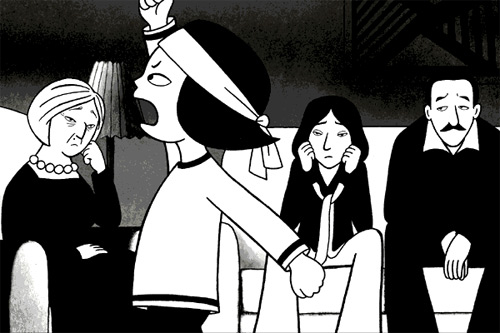
Persepolis the Film! Formal Discussion Post Due by End of Week!


For your next posting assignment (by the end of the week!), please watch the film version of Persepolis and then write a _longer_ post about the differences between reading a comic and watching a film version of the comic. What are the differences and continuities you see between the two forms of media?

The film was made in French and has English subtitles. How does that affect your experience? How does the music the creators used alter the viewer's experience of the film?


See Persepolis here

Friday, February 19, 2016

Midterm Instructions--DUE MARCH 4

General Directions: Write a 6-7 page paper addressing one of the following.  Below, please find a number of questions focusing on the works we’ve read during the first half of the term.  It’s important that your readings from Scott McCloud factor into your essay.  Use the terminology McCloud introduces in Understanding Comics to unpack the particularities of the text you choose to explore.  You may also want to use scanned or photocopied images to support your argument.  These images will be in addition to the 6 page minimum, rather than a part of the 6 pages. We can discuss how to “quote” from images. If you would like to use other theoretical sources on comics, I can help you find them.
Some general guidelines:
Handing in your paper late will lower your grade. As a rule, it is good to avoid using the first person in a formal paper.  Be certain to use spelling and grammar check on your computer; I am expecting that I will not have to focus unduly on this aspect of your writing when grading your work.  Back up your arguments with quotes from the reading and properly cite these quotes in MLA format.  If you have questions about citation practice, there are a number of online resources that can help you and I am happy to give you input, as well.  If you wish to work on a topic not listed below, just make sure to discuss it with me before beginning the work so we ensure it is narrow enough to fit within such a short paper.  I would be pleased to meet with you over the course of the next weeks to discuss your midterm paper if it would be helpful. Do not plagiarize! I am expecting that you won’t, but, if you do, it results in an automatic “F.”
Maus:
1. History, both global and personal, plays a large role in Maus. What is the relationship between personal history and global history in this text? How does Spiegelman balance narration of personal history and larger world historical events? How is the loss of his mother’s diary used as a thread to connect these two forms of history? How do the different genres evident in Spiegelman’s text – testimony, oral narrative, maps – work to do the same? Using specific examples, talk about how Spiegelman’s narrative choice to interweave losses both personal and large-scale works in Maus.
2. We mentioned in our discussion online that artists who wish to represent the Holocaust and the havoc it wreaked on its victims and survivors have a daunting task.  How does Spiegelman’s choice to represent the Holocaust in the form of a graphic novel allow him to address/ not address these questions of representation? Does the pictorial form of the graphic novel provide Spiegelman with a way of meditating on questions of representation? If so, how? Give specific examples and explain how they link to the larger issues surrounding representation of trauma.
3. Framing devices are very important to how we read and understand Art Spiegelman’s Maus. Most significant of the framing devices in the text is Art’s relationship with Vladek, which structures how we, as readers, interpret the novel, comprised as it is of testimony he collects from his aging Holocaust survivor father.  Keeping the importance of framing devices in Spiegelman’s work in mind, what do you make of the epigraphs that begin each volume of Maus? How do they work to introduce and structure our reading of the text? How do they create or disrupt continuity between the volumes? Use Spiegelman’s epigraphs to explore Maus and the role of framing in the text.
4. Art Spiegelman’s choice to portray the conflict between Nazi and Jew in World War II era Europe as a battle between cat and mouse drew much attention when Maus was published.  How does Spiegelman’s use of animals to represent national or ethnic types work in Maus?  Use close readings of a few scenes in the text to explain how Spiegelman’s animal characters allow him to comment on the historical circumstances of the war and the place of racial-thinking in it.
Persepolis:
1.      1. Both Maus and Persepolis are memoirs written in graphic narrative form.  However, Spiegelman and Satrapi’s narratives differ in key ways.  How does Satrapi’s choice to frame the story of the Islamic Revolution in Iran through the eyes of a child affect your reading of her story?  How does this choice contrast with Spiegelman’s more cynical, by-proxy narrative of the Holocaust?  How do Spiegelman and Satrapi use imagery differently/ similarly?
2.      2. Satrapi’s Persepolis proves unique in the comics genre because it is centered on the viewpoint of a female child and, later, young woman.  How does gender factor into your experience of Persepolis?  Does Satrapi suggest something about the ways in which revolutions affect women in particular? How does Satrapi’s focus on female experience challenge our idea about the conventions of comics?
3.      3. Persepolis is very much a narrative about place and the role it plays in the formation of identity.  The characters in Satrapi’s memoir struggle to stay in a chaotic homeland or deal with the complexities of exile.  How does Satrapi use the physical space of the comic to comment on the power of geography during a period of social tumult?
     American Born Chinese
    1. As we discussed on the blog, the history of caricature and comics are intertwined.  How does Yang use caricature and offensive stereotype in American Born Chinese?  What visual and narrative choices does he make that demonstrate to us as readers that he is trying to undermine stereotype? 
2   2.  Yang combines folklore with more realistic, contemporary narrative, as well as sitcom-style storytelling in his book. He also combines Eastern and Western religion in American Born Chinese. What sort of story about culture do these cross-pollinations tell?  How do they complicate or extend the immigrant stories we normally hear?