Tuesday, April 12, 2016


The Arab of the Future


This week, we embarked on another intriguing journey with new and exciting characters. This graphic memoir depicts the author's father, Abdel-Razak Sattouf, go through the transition of living in a young, hopeful state of mind, to realizing that his country was not bound to catch up to freedom and falling into the negativity surrounding him. Essentially, it is the loss of innocence that Abdel-Razak experiences when he realizes that the world around him isn't changing. 


My question for you all is to discuss why you think Abdel-Razak was portrayed the way he was. It wasn't exactly a flattering portrayal, and his character was not highly likable. Being that this is a memoir, does that portray how the author feels about his father? Or is it something else entirely? How does racism come into play in this novel?

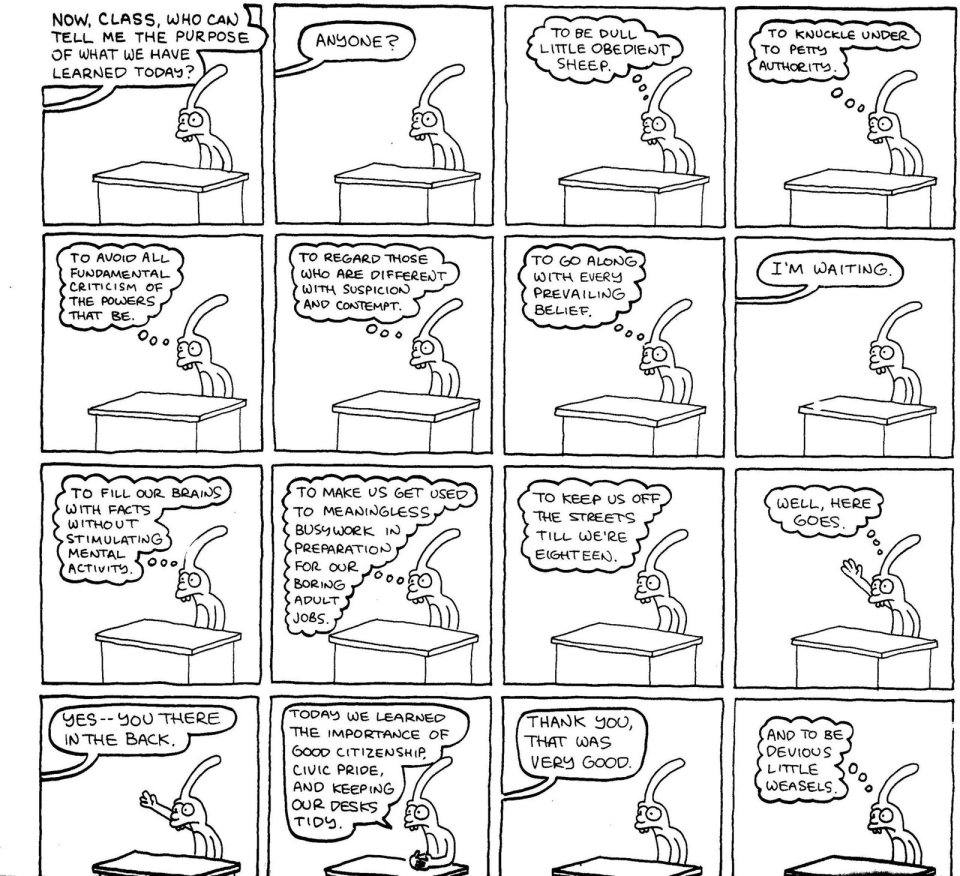
Final Paper Instructions


                                            (From Matt Groening's School is Hell)
Your final papers, due Friday, April 29th via email, should be somewhat more complex and research-heavy than your midterm papers. I also ask that the papers be 9-10 pages.

For this paper, I do not ask you to respond to a prompt, but instead to choose and explore a topic of particular interest to you. That means that you can look at a text or issue addressed in class that you DIDN'T explore in your midterm or transcend the boundaries of the class to focus on comics or issues in comics about which you are passionate.  I am more than happy to respond to ideas for papers and/ or provide you with a series of possible prompts if you like. However, you do have freedom to pursue what you choose.

As for finding research, I'd like you to include approximately three sources to enrich your argument (these might include peer-reviewed articles, books on comics lit or theory, or interviews with authors). I am also happy to help you find appropriate research for your chosen topic. By now, you should all have received your midterms with comments. I am happy to discuss them with you and help you figure out how to integrate my comments into final papers. Overall, I was impressed by the caliber of your work!

The Arab of the Future intro and comments post

This week, we've been reading The Arab of the Future, by Riyad Sattouf, a Syrian-French cartoonist living in Paris. Sattouf's work has been celebrated in Paris and throughout Europe--especially in the wake of the attacks on the Charlie Hebdo offices (he was once an illustrator for Charlie Hebdo).

 For more on the Charlie Hebdo shootings, check out this article/ timeline from the BBC.

For more on Sattouf, read this New Yorker profile.

At the same time that The Arab of the Future is immensely popular in France and, now, after its translation into English, in America, a number of critics have worried that the comics portray the Arab world in a negative light, trafficking in stereotypes about Arab physical and cultural difference. What do you think? Does Sattouf's work skate too close to caricature? Should a personal work about a group of individuals have to answer to critics about how it represents the larger groups to which these individuals belong? How does it differ from the memoir works we've read over the course of the semester?

How does Sattouf draw the differences between Arab characters and French characters and between his father and mother? What about the differences between France, Libya, and Syria? French and Arab children?

How do the recent events in France (both the terrorist attack at the concert and the attacks on the Charlie Hebdo offices) affect our reading of the graphic narrative?

As early as 2005/6, debates over the representation of the prophet Muhammed rocked Denmark, and, soon, the rest of Europe. Why are comics becoming such a flashpoint for debates about race, representation, and censorship in recent years?

Tuesday, April 5, 2016

Linda Barry's One Hundred Demons: an autobifictionalography


Linda Barry’s One hundred demons is a stark contrast from the other comics we have read in this course thus far. I think first and most notably is the style in which the comic is done. It seems assembled in a scrapbook fashion, each story has an intro page with miscellaneous drawings and seemingly three-dimensional adhesives and ends with a single drawing “summarizing” the story she just told.
Between these two book-ends is contained a sort of organized chaos that is her “autobifictionalography” What do you think of reading a comic that is both autobiographical and made up? Are there any stories that seem less “true” than the others? Do you believe that this is a commentary on the authenticity of our own memories?

            Along with embellished tales of her childhood, Barry also includes many exaggerated depictions of the people around her in her drawings. What did you think about her distinct style as I believe its much different than anything we have discussed or learned about in class.
One Hundred Demons
Lynda Barry


Barry's graphic novel contains various stories within it, which by far makes it one of the more interesting graphic novels we've come across during this course. These different autobiographical accounts have different imagery, and I want to discuss how these different artistic strategies portrayed different tone and mood throughout the first half of the novel.

I also would like to discuss the significance of the 100 demons and Buddhism throughout the story, and how this theology plays into the novel.

ALSO: Who's story was your favorite and why?


Friday, April 1, 2016

Fun Home 105 - End (Nehring)


Fun Home is a memoir written by Alison Bechdel, Alison like her father grew up with complicated feelings. They both were were attracted to the same sex. Knowing this, they have a lot of the same problems and are almost polar opposites, because they were attracted to their own gender. This also made them very similar.

From this point in the graphic novel we explore much of the later portion of Alison's life. While is does continue to skip around a bit. Chapter 5-6 seem to focus on her diary entries where she reflects, but the end of Chapter 6, her entries stop. 

Chapter 7, Alison talks about how for the first time when she is visiting her mother's friend Elly in New York with her dad and brothers, she notices gay people all around her for the first time. Later on in College Alison finally embraces her sexuality and joins the gay union club on campus. Finally, she learns about her father.

What do you think of Alison's relationship with her father? She tries to make a connection with him and he is just not willing to open up with her.

What do you think of Alison's reaction to the news? What do you think this symbolizes?

What do you think of her choice to use art in her work instead of doing a traditional memoir? What does it add and/or take away from the work?

Thursday, March 31, 2016

Fun Home: A Tragicomedy


Fun Home, by Alison Bechdel, is a memoir graphic novel that depicts her relationship with her father, and how despite her feelings that he was always someplace else mentally, and that they had very little in common, that in fact the two were very similar.

What we see in the second half of this graphic novel is more development and a better understanding of her stressed relationship with her father. The two bond over literature, and have this very emotional connection on that level, while still feeling that sense of detachment, as her father is repressing his sexuality.

We also see Alison's development, sexually and physically. She struggles with her identity, knowing that she has certain masculine qualities, and at a young age wishes she could identify as a boy, not understanding that sexuality and gender are two different things (at such an age, it would be rather confusing).

My question for you all is: when do you think Alison first discovers the difference between sexuality and gender, and when does she first have an inclination that perhaps her sexual attraction is to women? Hint: I would look to page 118; this is where I felt I saw it. Please discuss Alison's development and how you feel that affected her relationship with her father positively or negatively.

I would also like share, just for fun, the beginning/ending parallel of Icarus. I have attached the photo from the beginning, and now that we have finished the graphic novel, I challenge you to search the story of Icarus if you don't know it already, and try to relate that back to her relationship with her father considering the ending.